Social media has changed the way people find and consume information. Instead of intentionally searching for news, people encounter information while scrolling through a feed that is personalized to them. This makes misinformation especially complicated because false or misleading information can appear next to legitimate information and may be presented in exactly the same format. TikTok and Instagram are particularly interesting platforms to examine because both reply heavily on visual content and recommendation algorithms, but they use different strategies to address misinformation. Tiktok combines content moderation, fact checking, warnings, recommendation restrictions, and newer community based tools, while instagram, which is owned by Meta, had moved away from third-party fact-checking in the united states toward Community notes. Neither approach completely solves misinformation, but both demonstrates how platforms design can influence whether misleading information spreads.
TIKTOK’S APPROACH TO MISINFORMATION
Tiktok’s Community Guidelines prohibit misinformation that could cause significant harm to individuals or society. The platform specifically addresses areas such as health misinformation, election misinformation, conspiracy theories, misleadingly repurposed media, and AI-generated content. TikTok says it works with independent fact-checking partners and public health authorities when evaluating the accuracy of content. Importantly, TikTok does not only remove misinformation in the For You feed. Some content that may cause moderate harm is allowed to remain on the platform but is made ineligible for recommendation in the For You feed. TikTok can also apply warning labels to content that fact-checking partners cannot verify and can prompt users to reconsider sharing it. You can find most of the information on Tiktok community guidlines. This distinction between removing content and limiting its reach is important. Tiktok recommendation system is one of the main way users discover videos, so preventing questionable content from entering the For You feed can potentional reduce its exposure without requiring the platform to remove every piece of disputed information. Tiktoks own 2025 guide explains that harmful misinformation can either be removed or main ineligible for the For you feed depending on the violation
I have noticed personally that another part of this system while using TikTok. I see a lot of information on TikTok that i question, especially when people confidently make claims without providing reliable source. Users can report videos for misleading information, and I have also seen videos receive a warning telling viewers to “check your sources before sharing.” (image 1). I think this a useful feature because it introduces a moment of hesitation before someone shares a questionable video. Instead of simply assuming that something is true because it has thousands of like or views, the warning encourages the user to stop and investigate it.
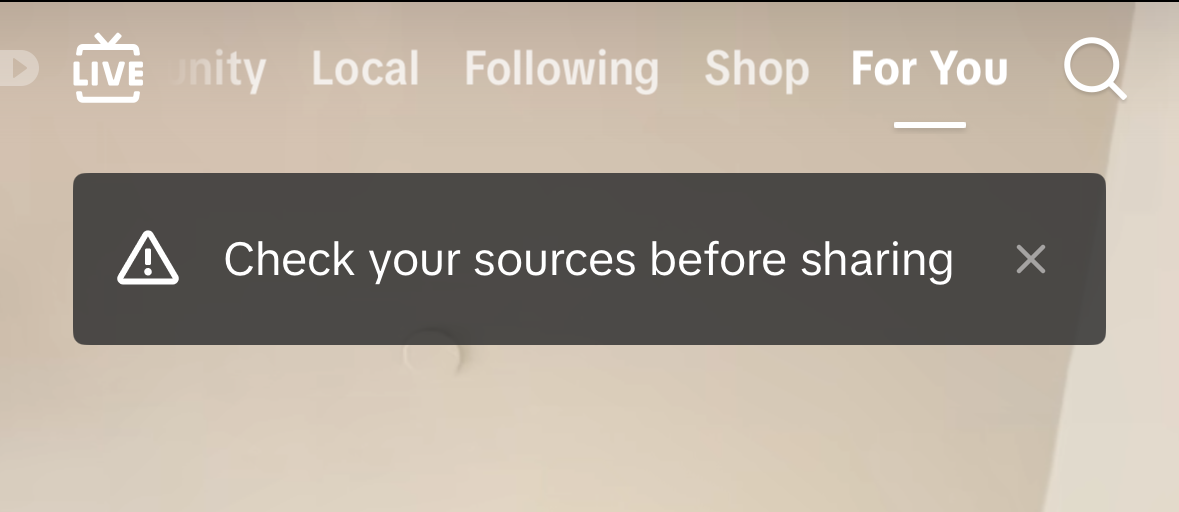
image 1
There is research supporting the general idea behind this type of warning. A 2022 study published in Nature Communications examined 20 experiments involving more than 26,000 participants and found that accuracy prompts improved the quality of information people chose to share, primarily by reducing their intention to share false headlines. This does not prove that tiktoks exact warning will eliminate misinformation, but it suggests that even a relatively small reminder to think about accuracy can influence sharing behavior.
Tiktok has also expanded its approach beyond traditional moderation. In July 2025 Tiktok introduced Footnotes in the US. Footnotes allow eligible community members to add additional context to videos, such as information that provides clarification or additional statistics. Tiktok reports that nearly 80,00 US users had qualified to contribute when it first began. Tiktok footnotes is significant because it gives user another way to respond to questionable information without necessarily removing the original video. Tiktok also has specific policies for AI generated content. Realistic AI generated or significantly edited content must be labeled, and certain misleading AI content is prohibited altogether, including content that falsely depict public figures taking positions on political issues or creating fake authoritative sources or crisis event. As generative AI makes realistic fake images, audio, and videos easier to create. These policies are increasingly relevant to misinformation.
Tiktoks system has several layers, users can report content, fact check, Tiktok can remove harmful information and questionable content can be excluded from recommendations, warnings can appear, and community members can add context. context. However, the platform still faces a major challenge: misinformation can spread before any of these systems have time to respond. This matters because TikTok has become a significant source of news. Pew Research Center reported in 2025 that 55% of TikTok users regularly get news on the platform, while 23% of TikTok news consumers said they see news there that seems inaccurate extremely or fairly often and another 49% said they sometimes see inaccurate information.
INSTAGRAM’ APPROACH TO MISINFORMATION
instagram’s approach is different because it is part of Meta. In the past, Meta relied on independent third party fact checkers to identify and label false information. In January 2025, Meta announced that it would end its third-party fact-checking program in the United States and move toward a Community Notes system. Community Notes began appearing on Facebook, Instagram, and Threads in the United States in April 2025. Under Community Notes, user can write notes provide additional context to posts. A note is not simply published because a majority of users approve of it. META says its system is designed to require agreement from contributors with different viewpoints before a note is displayed. Notes also have to include a supporting link.
This system has an important advantage, it give users an opportunity to see context rather than simply having a post removed. It also recognizes that misinformation can sometimes be difficult to classify as simply true or false. A post may contain a real photograph but present it without context, use an outdated event to describe something current, or make a technically true claim that creates a misleading impression. Adding context can address some of these situations more effectively than simply deleting the post.
My personal experience with instagram is a lot different than my experience with Tiktok a lot of that to do with me being on instagram a lot longer. I still encounter information that I think is fake or misleading, but i often find it easier to recognize because some of the misinformation seems extremely exaggerated or ridiculous. I sometimes see an instagram and immediately think that the claim does not sound believable enough to accept without checking it. This is only my personal experience, so it cannot demonstrate that Instagram objectively contains less misinformation. However, it does demonstrate an important part of the misinformation problem, the credibility of a claim depends a lot on how it is presented.
A claim that is ridculous looking may be easier for a user to question, while a polished video from a confident creator can feel much more convincing. This is one reason misinformation cannot be treated as only a technological problem Algorithms and platform policies matter, but so do human psychology, presentation, trust, and peoples willingness to verify information.
There is also research suggesting that warning labels and contextual information can make a difference. A 2024 study in Nature Human Behaviour analyzed 21 experiments involving more than 14,000 participants and found that fact-checking warning labels reduced both belief in and intentions to share false headlines. The effect remained even among participants who strongly distrusted fact-checkers.This is relevant to Instagram because it suggests that giving people additional information can influence how they respond to misinformation.
Community notes also have limitations. A misleading post can spread before a useful note is written and approved. The system depends on people recognizing accurate context. Research done on social corrections has also found a potential downside. While corrections can reduce belief in false information, incorrect corrections can also make people less likely to believe true information. Involving users in misinformation moderation does not automatically guarantee accurate results.
HOW TO IMPROVE THESE EFFORTS
I think both platforms could improve by combining their existing approaches instead of relying on one solution. First, platforms should continue using accuracy prompts and warnings before users share questionable content. Research suggests that these small interventions can reduce the sharing of false information. Tiktoks source checking reminder is an example of a relatively simple intervention that can be expanded.
Secondly, platforms should make their moderation systems more transparent. If a post is removed, labeled, or prevented from being recommended, users should have a clear explanation of why. Transparency could help users understand that moderation decisions are based on specific standards rather than making the system seem random.
CONCLUSION
Tiktok and Instagram have demonstrated that misinformation cannot be solved through one strategy. Tiktok uses reporting, fact checking, warnings, Ai Labels, and footnotes. While instagram uses community Notes to provide additional context. My experience on both platforms show why these efforts are important. Reducing misinformation requires more than removing false posts. Platforms should combine effective moderation, transparency, media literacy, and tools that encourage users to question information and verify sources before sharing.